
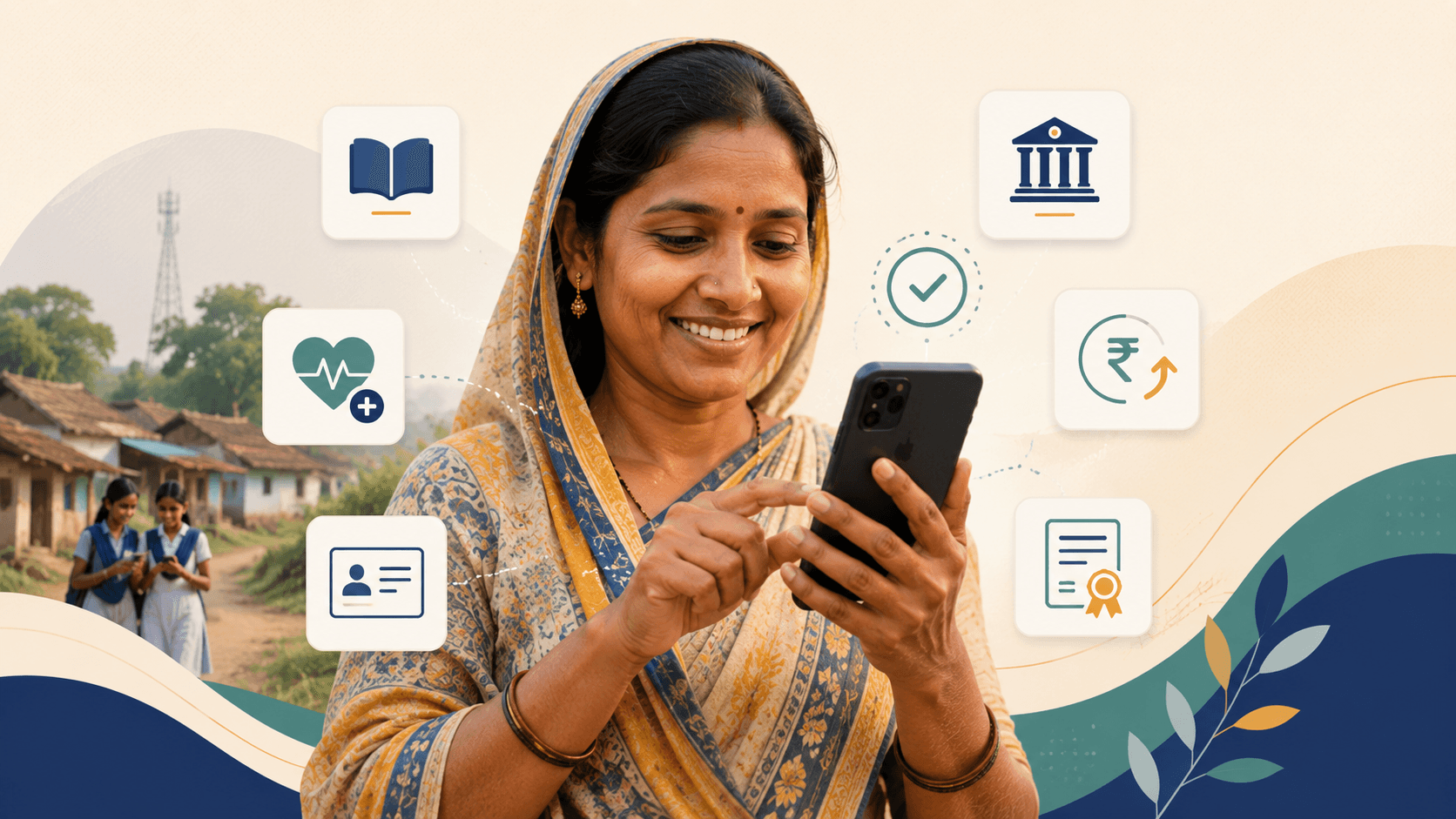
India has built some of the world’s most ambitious digital systems. Their true success, however, is measured at the last mile: can a person use them safely, understand what is happening and recover when something goes wrong?
At a community help desk in North Delhi, a woman arrives with an Aadhaar card, a bank passbook and a phone with a cracked screen. She wants to know whether an important application has been approved. The answer is online, but the portal switches between Hindi and English, the one-time password reaches a shared family phone, and the session expires before she can complete the process. A task designed to save time turns into travel, waiting and dependence on a stranger.
This scene is an illustrative composite, but the barriers are real and familiar. India’s digital transformation has created extraordinary new possibilities, yet meaningful access remains uneven. The challenge is not only whether a signal reaches a neighbourhood or whether a household owns a smartphone. It is whether the person who needs a service can use it confidently, privately and without surrendering control.
The digital divide is now a question of agency
A person may technically be “connected” and still be unable to complete the task that matters. The phone may be shared. Mobile data may be rationed. A woman may not control the device or SIM linked to her account. An older person may depend on a neighbour to read a message. A person with a disability may find that a portal does not work with assistive technology. Someone may be comfortable watching videos but unsure how to identify an official website, protect a password or recover from a failed payment.
Globally, the International Telecommunication Union estimated that six billion people were online in 2025, while 2.2 billion remained offline. It also warned that affordability, quality, skills and urban–rural inequalities continued even where mobile broadband coverage existed.[2] Connectivity is necessary, but it does not automatically create capability.
“Digital inclusion begins with access, but dignity begins when people have enough understanding, safety and control to act for themselves.”
India’s digital public infrastructure: scale with responsibility
India’s digital public infrastructure, or DPI, can be understood as a set of shared digital rails that different public and private services can use. It is not one app. It is an ecosystem of interoperable building blocks: Aadhaar for digital identity, UPI for instant payments, DigiLocker for verified documents, and connected layers such as eSign, direct benefit transfers and secure data exchange. UNDP describes rights-based DPI as shared, secure and interoperable systems governed to expand access, innovation and trust at societal scale.[3]
India’s digital rails are powerful; inclusion depends on how people experience them at the last mile.
The scale is remarkable. In June 2026, UPI processed about 22.7 billion transactions worth approximately ₹28.92 lakh crore.[4] UIDAI reported an average of 9.6 crore Aadhaar authentications per day during 2024–25,[5] while MeitY’s 2025–26 annual report recorded 62.10 crore DigiLocker users and more than 941.45 crore issued digital documents.[6] These figures demonstrate reach and utility. They do not, by themselves, prove that every user can complete every task easily, safely or independently.
A real example: Bank Sakhis turn digital rails into local access
A useful Indian example is the Bank Sakhi model. Launched through the National Rural Livelihoods Mission in partnership with the World Bank, the programme trains women from self-help groups to work as local banking agents. A 2023 World Bank study reported that the initiative was active across 20 states and had onboarded more than 100,000 women. Bank Sakhis help people open accounts, make deposits and withdrawals, access loans and understand financial services—often closer to home and in a more familiar social setting.[7]
The model matters because it combines technology with trust. A digital identity or payment network may provide the rail, but a trained local woman can provide explanation, reassurance and a path through failure. The same research also shows that human support must be backed by good training, reliable grievance redressal and adequate operational support. Technology and community are not substitutes for each other; at the last mile, they work best together.
Begin with the task, not the technology
People rarely wake up wanting “digital transformation”. They want to download a school certificate, check a scholarship, book a health appointment, receive a payment, apply for a job or correct an error in an official record. The task is ordinary; the cost of failure is not. A failed process can mean a lost day’s wage, repeated travel, a missed deadline, a financial loss or the embarrassment of handing a phone and personal information to someone else.
A responsible intervention therefore starts with observation rather than software. What is the person trying to achieve? At which step do they hesitate, abandon the process or surrender the device? Is the barrier language, connectivity, disability access, identity verification, fear of fraud, a document mismatch or an unclear error message? The right response may be a simpler form, a local-language guide, a voice-based explanation, an assisted help desk, an offline route or a better grievance process. It may not require a new app at all.
The dignity-first test
- Can the task be completed on a low-cost phone and an inconsistent connection?
- Can a first-time user understand the language, instructions and next step?
- Can a person with a disability use the service with appropriate assistive technology?
- Is it clear what personal data is being requested, for what purpose and for how long?
- Can the user recover from an error without losing money, progress or confidence?
- Is there a reliable human and non-digital alternative when the online route fails?
- Does the person leave more independent than when they arrived?
Five principles for technology that respects dignity
1. Design for the device and connection people actually have
Public-interest technology is often tested on fast networks, large screens and modern devices. Real users may have limited storage, an ageing battery, a shared SIM and interrupted data. Essential services should load quickly, save progress, avoid compulsory downloads and provide clear confirmation when a task is complete.
The best interface is not the one with the most features. It is the one that allows the person to finish the task with the least confusion and the lowest cost.
2. Use language, accessibility and clarity as infrastructure
Translation is not enough when the underlying process is still difficult to understand. Instructions should use familiar words, short steps, meaningful icons and examples. Voice guidance, readable text sizes, keyboard navigation, screen-reader compatibility and captions should be treated as essential design requirements—not optional additions.
A user should always know where they are, what will happen next and whether the action succeeded.
3. Teach transferable skills and practise “do with, not do for”
Digital training often becomes a demonstration: press this button, then that one. The learner succeeds once but cannot adapt when the interface changes. Stronger programmes teach patterns that travel across platforms—how to identify an official source, recognise a suspicious link, create a secure password, change the language, save a document and verify that a payment has actually gone through.
Assisted access remains important, but the user should hold the device wherever possible. The objective is not to finish the task fastest; it is to help the person finish it again next time.
4. Treat privacy, consent and fraud prevention as part of dignity
People seeking help may be asked to reveal identity numbers, health information, bank details, passwords and one-time codes. Good intentions do not remove risk. Organisations should collect only what is needed, explain the purpose in plain language, avoid retaining credentials and provide privacy for sensitive tasks.
India’s Digital Personal Data Protection framework reinforces the need to process personal data lawfully and to respect individuals’ rights.[10] Practical safety also means teaching people never to share an OTP, how to verify customer-care channels and what to do after a suspicious transaction.
5. Design for failure—and measure independence rather than attendance
Every digital system eventually encounters a mismatch, timeout, rejected document, failed payment or lost device. A dignity-first service makes recovery visible: progress can be resumed, errors are explained, corrections are possible and a human grievance route is easy to find.
Counting registrations, apps installed or workshop attendance is simple. Better questions are more demanding: Can the person repeat the task a month later? Did they save time or travel? Do they keep credentials private? Were completion rates different for women, rural users, people with disabilities or older devices? The strongest outcome may be fewer people returning for the same basic task because they can now complete it themselves.
Where technologists and NGOs can make the greatest difference
A technical background is valuable in the social sector not only because it enables someone to build software. It helps reveal why systems fail: a form that resets after an OTP timeout, a workflow that assumes everyone has an email address, a page that consumes too much data, an inaccessible PDF, a dashboard that counts activity but hides exclusion, or a verification process with no correction route.
The most useful role for a technologist may be that of translator between field reality and system design. Sit beside users. Map the full journey. Notice where they pause, repeat a step, ask for reassurance or hand over the phone. Then remove unnecessary fields, improve error messages, reduce data use and make the grievance path visible.
NGOs occupy a valuable position between large systems and everyday experience. They can document recurring barriers, test services with real users, teach safe and repeatable skills, and bring evidence from the community into policy and product discussions. Their task is not to become a permanent substitute for inaccessible systems; it is to help make those systems more understandable, accountable and inclusive.
Policy recommendations: from digital scale to dignified access
India’s next phase of digital inclusion should protect the gains of DPI while addressing the conditions that prevent people from using it. The following priorities draw on international guidance on inclusive DPI, digital literacy and last-mile service delivery.[3][8][9]
- Keep essential services multi-channel. No person should lose an entitlement because they cannot use one digital route. Online services should be supported by assisted, telephone and in-person alternatives.
- Set minimum inclusion standards. Public services should meet low-bandwidth, local-language, accessibility, clear-status and error-recovery requirements before large-scale rollout.
- Fund trusted community support. Train and compensate community facilitators, including women-led models such as Bank Sakhis, while ensuring they build user independence rather than permanent dependence.
- Build privacy and safety into delivery. Use data minimisation, plain-language notices, secure devices, no-credential-retention rules and practical fraud education at every assisted-access point.
- Publish outcome—not only scale—metrics. Report completion, failure, grievance resolution and repeat-use outcomes, disaggregated by gender, location, disability, language and device constraints.
- Make correction and grievance routes visible. Every essential system should offer a clear way to correct records, challenge a decision, track a complaint and reach a responsible human within a defined time.
A practical starting point for V Devi Foundation
The Foundation does not need to begin with a large technology project. It can select one high-friction community task—for example, retrieving an educational document, applying for a scholarship or checking the status of a public service—and observe five to ten people attempting it. The team can map each point of confusion, create a low-data Hindi guide, train volunteers in privacy-safe assistance and check after one month whether participants can repeat the task independently. A small, well-measured pilot can generate stronger evidence than a large but poorly understood intervention.
Conclusion: the last person is the real measure of innovation
India’s digital future should not be judged only by transaction volumes, app downloads or identities issued. It should also be judged by whether a woman can check a payment without sharing her OTP, whether a student can retrieve a certificate on an older phone, whether a migrant worker can correct a mismatch without losing a day’s wage, and whether an older person can ask for help without surrendering control.
Technology becomes infrastructure when it is reliable. It becomes public infrastructure when it is accountable. It becomes dignifying when it expands a person’s agency—their ability to understand, choose, act and recover.
“The last person should not be asked to adapt endlessly to the system. The system should be designed to meet them where they are.”
Sources and further reading
- GSMA, “India’s Digital Economy Powers Ahead: Innovation and Inclusion Hold the Key,” 9 October 2025. View source
- International Telecommunication Union, “Measuring Digital Development: Facts and Figures 2025,” November 2025. View source
- United Nations Development Programme, “The DPI Approach: A Playbook,” August 2023. View source
- National Payments Corporation of India, “UPI Product Statistics,” June 2026. View source
- Unique Identification Authority of India, “Annual Report 2024–25,” published January 2026. View source
- Ministry of Electronics and Information Technology, Government of India, “Annual Report 2025–26.” View source
- World Bank, “Women Agents for Financial Inclusion: Exploring the Benefits, Constraints, and Potential Solutions,” 2023. View source
- United Nations Development Programme, “Digital Inclusion Playbook 2.0,” September 2024. View source
- World Bank, “What Works to Advance Women’s Digital Literacy? A Review of Good Practices and Programs,” 2025. View source
- Government of India, “The Digital Personal Data Protection Act, 2023.” View source